TL;DR
England, Scotland and Wales each make it an offence to supply a single-use polystyrene cup, in three separate texts. England (regulation 5 of the 2023 Regulations) and Scotland (regulation 3 of the 2021 Regulations) catch a business that supplies or offers to supply, and Scotland also catches possession for supply and manufacture. The Welsh Act 2023 is drawn around supply to a consumer in Wales. Local authorities enforce all three, each text has a due diligence defence, and fixed penalties of £200 exist in each nation: under the English 2023 Regulations, under the Welsh civil sanctions Regulations 2023 and, in Scotland, under the 2021 Regulations as amended in 2025.
Ask who is liable when a polystyrene cup reaches a bar and the answer depends on which nation the bar is in. England, Scotland and Wales each wrote their own text, and the three differ on who commits the offence, who enforces it and what the penalty is. Our guide to what the UK single-use plastic rules ban covers which products are caught. This article covers what follows when one is supplied. It reads the texts as they stand on 26 October 2026 and is not legal advice.
England
The Environmental Protection (Plastic Plates etc. and Polystyrene Containers etc.) (England) Regulations 2023 came into force on 1 October 2023. Regulation 1(3) says they extend to England and Wales and apply in relation to England only.
Under regulation 5, a person who, in the course of a business, supplies or offers to supply a single-use polystyrene cup, or a single-use polystyrene food or drink container, is guilty of an offence. Regulation 2 defines supply as supply whether by way of sale or not, so a cup handed out free is covered. The defined cup is one made wholly or partly from expanded or foamed extruded polystyrene and not designed or intended to be re-used.
Regulation 3, on plastic plates, trays and bowls, applies to supply to an end user. Regulation 5 does not use those words. In our reading, a polystyrene cup sold from one business to another is therefore within regulation 5. The GOV.UK guidance fits that reading: it lists food and drink containers made of expanded and extruded polystyrene among the banned items and says there are no exemptions to the ban on them, while for plates, bowls and trays it exempts supply to another business. The guidance does not name cups.
On the penalty, regulation 5(2) says a person guilty of the offence is liable on summary conviction to a fine, and states no amount. Regulation 9 and Schedule 1 add civil sanctions. A local authority, which regulation 2 defines as the regulator, may impose a fixed monetary penalty of £200 under the 2023 Regulations, or a compliance notice, once it is satisfied beyond reasonable doubt that the offence was committed. The notice of intent must offer the chance to discharge the penalty by paying £100 within 28 days of receiving it, and the person can make representations within the same 28 days. Schedule 1 also provides for stop notices, enforcement undertakings, non-compliance penalties and enforcement cost recovery notices.
Regulation 6 gives a defence to a person who took all reasonable steps and exercised all due diligence to avoid committing the offence. Where the defence rests on information supplied by another person, regulation 6(4) asks whether it was reasonable to rely on it, having regard to the steps taken, and those which might reasonably have been taken, to verify it and to whether there was reason to disbelieve it. Regulation 7 sets the time limits: an information may be tried if it is laid within twelve months after the date on which evidence sufficient, in the opinion of the prosecutor, to justify the proceedings comes to the prosecutor's knowledge, and no proceedings may be brought more than three years after the offence.
GOV.UK says local authorities carry out inspections and that inspectors can visit a shop or store, make test purchases, speak to staff and ask to see records. It says a business that breaks the law could be fined and ordered to cover the cost of the investigation, and that an appeal can be made within 28 days of getting a fine.
Scotland
The Environmental Protection (Single-use Plastic Products) (Scotland) Regulations 2021 came into force on 1 June 2022 and, under regulation 1(2), extend to Scotland only.
Regulation 3(1) makes it an offence for a person who, in the course of a business, supplies, offers to supply or has in their possession for supply any of the listed products, which include single-use expanded polystyrene beverage cups. Two features go further than the English text. Possession for supply is caught, so stock held ready for a bar is within the offence on its wording. Regulation 3(2) also makes it an offence to use expanded polystyrene to manufacture the cups. Regulation 2 defines the cup as a cup for beverages, including any cover or lid, that is made wholly or partly from expanded polystyrene and is single-use, and supply again means supply whether by way of sale or not.
The penalty on conviction is a fine not exceeding level 5 on the standard scale (regulation 3(5)). Regulations 16 to 18 add fixed penalty notices, and the revised text carries an amendment note saying they were inserted from 31 March 2025 by S.S.I. 2025/28. An enforcement officer who has reason to believe an offence has been committed may give a fixed penalty notice, but not more than 14 days after the day of the offence. The fixed penalty is £200 under the 2021 Regulations as amended in 2025, with a discounted amount of £100 if it is paid within 14 days of the notice, and otherwise it is payable within 28 days. The notice must explain that the person is not required to accept the offer and may be prosecuted instead.
Enforcement sits with local authorities, which under regulation 14 may authorise a person in writing to exercise the powers of entry and examination in regulation 15. Regulation 12 adds that where a body corporate, a Scottish partnership or an unincorporated association commits an offence with the consent or connivance of, or through neglect by, a relevant individual such as a director, manager or partner, that individual commits it as well. Regulation 13 gives a defence to a person who took all reasonable precautions and exercised all due diligence.
Wales
In Wales the ban is in the Environmental Protection (Single-use Plastic Products) (Wales) Act 2023. Section 2 makes a product prohibited if it is listed in the Table in the Schedule and no exemption applies. The Table lists cups, with the exemption that a cup not made of expanded or foamed extruded polystyrene is not prohibited, so a cup made of that material is.
Section 5 is drawn around the consumer. A body corporate, partnership, unincorporated association or sole trader commits the offence by supplying a prohibited product to a consumer who is in Wales, which includes arranging delivery to an address in Wales, or by offering to supply it to a consumer on premises in Wales. Supplying means selling the product or providing it free of charge, and offering includes displaying it or keeping it on the premises so that a consumer can reach it. A consumer is an individual acting for purposes wholly or mainly outside their trade, business or profession. On that wording, and in our reading, a sale of polystyrene cups from one business to another is outside section 5 itself, while cups handed to the public at a bar or stall in Wales are inside it.
Section 5(7) gives a defence to a person who exercised all due diligence and took all reasonable precautions. Section 6 makes the offence punishable on summary conviction by a fine, with no amount stated. Section 7 lets a local authority, meaning a county council or county borough council in Wales, investigate complaints, bring prosecutions and take other steps to reduce offences in its area.
Section 17 let the Welsh Ministers make civil sanctions by regulations, and the Environmental Protection (Single-use Plastic Products) (Civil Sanctions) (Wales) Regulations 2023 came into force on 1 December 2023, with local authorities as the regulator. The fixed monetary penalty is £200 under those 2023 Regulations. A notice of intent must say that liability can be discharged by paying 50 per cent of the penalty within 28 days of receiving it. If a final notice follows, the penalty is payable within 56 days, and after that the amount payable rises by 50 per cent. The Regulations also provide for variable monetary penalties, compliance notices, stop notices and enforcement undertakings.
What it means for an event organiser
The three texts agree on the core: a polystyrene cup supplied in the course of a business is an offence, local authorities enforce it, and each gives a due diligence defence. They differ on who is caught. England and Scotland catch a business supplying at any point in the chain on their wording, Scotland adds possession for supply and manufacture, and Wales is drawn around supply to a consumer. Each text also defines single-use in its own words, so, in our view, a claim that a polystyrene cup is reusable should be tested against the definition of the nation where it is supplied.
An organiser running events in more than one nation is working with three sets of wording. In our view the practical rule is the strictest one: no expanded polystyrene cups in any stock, in any nation. Regulation 6(4) in England points to the steps taken to verify information from a supplier, and in our reading a written statement of the material of a cup order is the kind of step it has in mind, though the sources do not say so.
On the product side
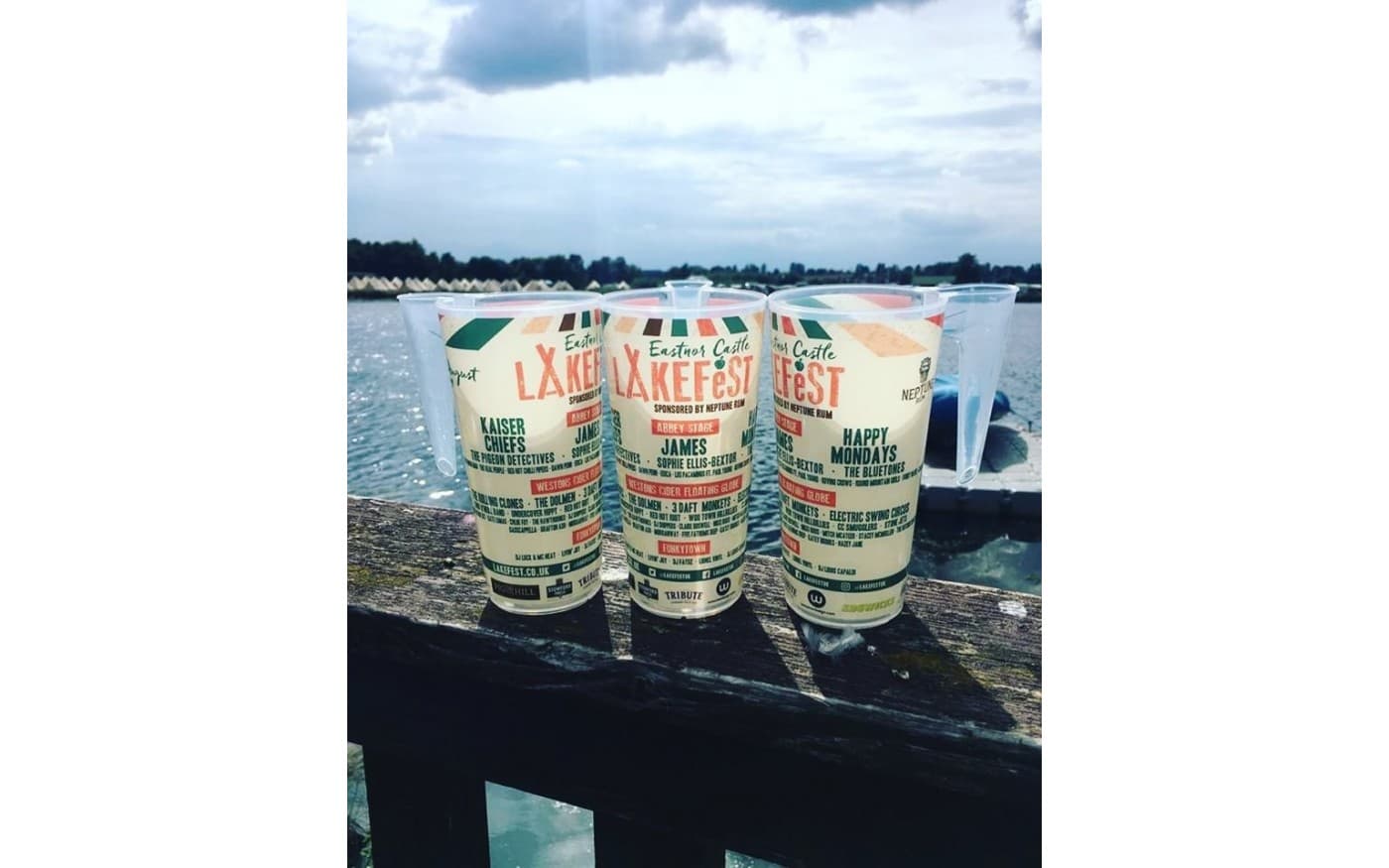
The reusable event cups on this site give polypropylene as their material, and the paper festival cups page describes printed paper pint and half-pint cups. Neither page mentions polystyrene. A free sample cup can be ordered to see the cup in hand, and a quote can be asked for by choosing the cups, then the quantities and delivery options.
Where this stands
This was checked on 26 October 2026. The pages read show no known outstanding effects on the English and Scottish regulations or on section 5 of the Welsh Act. The one pending change on the Welsh Schedule adds wet wipes from 18 December 2026 and does not touch cups. The Welsh civil sanctions Regulations are held on legislation.gov.uk in their original form only. The GOV.UK guidance was last updated on 7 October 2024.
Frequently Asked Questions
Who can be prosecuted for handing out a polystyrene cup at an event?
In England, a person who in the course of a business supplies or offers to supply one (regulation 5 of the 2023 Regulations). In Scotland, a person who in the course of a business supplies, offers to supply or holds one for supply, or uses expanded polystyrene to make it (regulation 3 of the 2021 Regulations). In Wales, a body corporate, partnership, unincorporated association or sole trader that supplies a prohibited cup to a consumer in Wales or offers it on premises there (section 5 of the 2023 Act).
What is the penalty for supplying a polystyrene cup?
On summary conviction a person is liable to a fine in each nation: no amount is stated in the English or Welsh texts, and the Scottish text says a fine not exceeding level 5 on the standard scale. Fixed penalties of £200 exist under the English 2023 Regulations, the Welsh civil sanctions Regulations 2023 and, since 31 March 2025, the Scottish 2021 Regulations as amended.
Does the polystyrene cup ban apply to a sale between two businesses?
In England and Scotland the offences are written for a person who supplies in the course of a business, without an end user condition, and the GOV.UK guidance says there are no exemptions to the ban on polystyrene food and drink containers. The Welsh offence is about supply to a consumer, so in our reading a business to business sale falls outside section 5 itself.
Who enforces the ban on polystyrene cups?
Local authorities in all three nations. In England the regulator is a local authority, in Scotland a local authority authorises the enforcement officers, and in Wales a county or county borough council can investigate and prosecute and is the regulator for civil sanctions.
Is there a defence if a supplier delivered polystyrene cups by mistake?
Each text gives a due diligence defence. England asks whether the person took all reasonable steps and exercised all due diligence, Scotland all reasonable precautions and due diligence, and Wales due diligence and all reasonable precautions. Where the defence rests on information from another person, the English text asks whether it was reasonable to rely on it. In England and Scotland, a defence that blames another person also depends on serving the prosecutor with a notice identifying that person before the hearing, unless the court gives leave (regulation 6(2) and (3) in England, regulation 13(2) in Scotland).
How we checked this article
Checked on 26 October 2026 (sources first read on 14 October 2026 and re-opened), the texts first and the guidance second. England: regulations 1 to 11 and Schedule 1 of the Environmental Protection (Plastic Plates etc. and Polystyrene Containers etc.) (England) Regulations 2023 (S.I. 2023/982) were read in revised form on legislation.gov.uk, and the pages show no known outstanding effects. Scotland: regulations 1, 2, 3, 6 to 14, 16, 17 and 18 of the Environmental Protection (Single-use Plastic Products) (Scotland) Regulations 2021 (S.S.I. 2021/410) were read, the exemptions in regulations 6 to 11 applying only to single-use plastic straws, and the contents page shows no known outstanding effects. Regulations 16 to 18 carry an amendment note saying they were inserted from 31 March 2025 by S.S.I. 2025/28; that instrument was not opened. Wales: sections 1, 2, 5, 6, 7, 17, 20 and 22 and the Schedule of the Environmental Protection (Single-use Plastic Products) (Wales) Act 2023 were read; the section pages show no known outstanding effects, and the Schedule page lists one pending change, S.I. 2025/716, which was opened and concerns wet wipes from 18 December 2026 and does not touch cups. The Environmental Protection (Single-use Plastic Products) (Civil Sanctions) (Wales) Regulations 2023 (S.I. 2023/1288) were read in the original version, which is the only version legislation.gov.uk holds. The commencement date of 30 October 2023 for the Welsh sections is taken from the commencement notes on the section pages; S.I. 2023/1149 was not opened. The GOV.UK guidance Single-use plastics bans and restrictions (Defra, published 22 January 2024, last updated 7 October 2024, applies to England) was read for enforcement and for the exemptions; it does not name cups. Its GOV.UK content record carries a later technical stamp of 21 October 2026 with no change note and no new public update date; the banned items, the exemptions and the enforcement text were re-read and match what is reported here. The amounts of the fixed penalties are those written in the texts; the texts for England and Wales give no amount for the fine on conviction, and the Scottish text gives level 5 on the standard scale. Not read: guidance from the Scottish Government or the Welsh Government, case law, sentencing guidelines, Northern Ireland. The material of the Branded Cups products comes from the reusable event cups listing and the paper festival cups page, neither of which mentions polystyrene. Statements marked as our reading are inferences from the wording and not statements in the sources.
- Published by
- Branded Cups Ltd
- Sources last checked
- 2026-10-26
Sources
- The Environmental Protection (Plastic Plates etc. and Polystyrene Containers etc.) (England) Regulations 2023, contents (regulations 1 to 11)
- The Environmental Protection (Plastic Plates etc. and Polystyrene Containers etc.) (England) Regulations 2023, Schedule 1 (civil sanctions)
- The Environmental Protection (Single-use Plastic Products) (Scotland) Regulations 2021, contents
- The Environmental Protection (Single-use Plastic Products) (Scotland) Regulations 2021, regulation 18 (fixed penalty amounts)
- Environmental Protection (Single-use Plastic Products) (Wales) Act 2023, contents
- Environmental Protection (Single-use Plastic Products) (Wales) Act 2023, Schedule (prohibited single-use plastic products)
- The Environmental Protection (Single-use Plastic Products) (Civil Sanctions) (Wales) Regulations 2023
- The Environmental Protection (Single-use Plastic Products) (Wet Wipes) (Wales) Regulations 2025
- GOV.UK, Single-use plastics bans and restrictions (England)
- Branded Cups, Reusable event cups
- Branded Cups, Paper festival cups