TL;DR
The Food Standards Agency says the national food contact regulations of 2012 include provisions for materials such as printing inks. The good manufacturing practice regulation, 2023/2006, requires inks applied to the non-food-contact side to be formulated and/or applied so that substances do not transfer to the food-contact side through the substrate or by set-off in the stack, at levels not in line with article 3 of Regulation 1935/2004. Printed articles must be handled and stored in the same way, and the printed surfaces shall not come into direct contact with food. The FSA's post implementation review of the England Regulations 2012 lists specific measures for plastics, ceramics and other materials, and printing inks are not among them.
A printed cup is a drinking vessel with ink on it, and the ink is not exempt from food contact rules. This article sets out what those rules say about it, what they leave to the supplier, and what a buyer can reasonably ask.
The general rule
Assimilated Regulation (EC) No 1935/2004 is the framework regulation for materials and articles intended to touch food or drink, and its article 3 sets the general requirement. Materials and articles must be manufactured in compliance with good manufacturing practice so that, under normal or foreseeable conditions of use, they do not transfer their constituents to food in quantities which could endanger human health, bring about an unacceptable change in the composition of the food, or bring about a deterioration in its organoleptic characteristics. The Food Standards Agency's overview of the national food contact regulations of 2012 says they include provisions for materials such as printing inks and adhesive labels. The overview applies to England, Northern Ireland and Wales and carries a date of 24 April 2018, so the statutory text was read directly.
The rule for ink
The specific rule sits in the Annex to Commission Regulation (EC) No 2023/2006 on good manufacturing practice. Part A deals with processes involving the application of printing inks to the non-food-contact side of a material or article, and it has three paragraphs.
The first says inks applied to the non food-contact side shall be formulated and/or applied in such a manner that substances from the printed surface are not transferred to the food-contact side, either through the substrate or by set-off in the stack or the reel, in concentrations that lead to levels of the substance in the food which are not in line with the requirements of article 3 of Regulation 1935/2004. The second applies the same test to handling and storage: printed materials and articles must be handled and stored, finished and semi-finished, so that the same transfers do not occur. The third is short: the printed surfaces shall not come into direct contact with food.
Article 3 of Regulation 2023/2006 itself defines the non-food-contact side as the surface of the material or article that is not directly in contact with food, and the food-contact side as the surface that is directly in contact with it. Article 2 says the regulation applies to all sectors and to all stages of manufacture, processing and distribution of materials and articles, up to but excluding the production of starting substances, and article 4 makes the business operator responsible for ensuring that manufacturing operations are carried out in accordance with the general rules and with the Annex.
What the rule does not contain
It names no ink and sets no numerical limit. The test is the one in article 3 of the framework regulation. The FSA's post implementation review report on the England Regulations 2012 says the framework regulation applies to all food contact materials regardless of composition and lists the materials for which specific measures have been adopted: plastics, recycled plastics, ceramics, regenerated cellulose film, active and intelligent materials, vinyl chloride monomer and certain epoxy derivatives. Printing inks are not on that list. The same report describes the good manufacturing practice regulation as requiring businesses to establish and document good practices and procedures and to make sure the manufacturing process is well controlled. GOV.UK shows the report as published on 25 June 2026, the day the FSA moved its website to GOV.UK, but its text mentions nothing later than autumn 2023 and it applies to England only, so its list describes the position when it was written.
Where a printed cup fits
What follows is our reading of the Annex, and it is not a statement from a regulator. A drink touches the inner wall of a cup, so the outer wall is the non-food-contact side, and print on it is what paragraph 1 is written for. Cups are usually nested for storage and transport, which is the situation the phrase set-off in the stack points to, though the Annex does not mention cups. That makes paragraph 2, on handling and storage, worth a question to a supplier. Paragraph 3 would matter if any print sat on the surface that touches the drink.
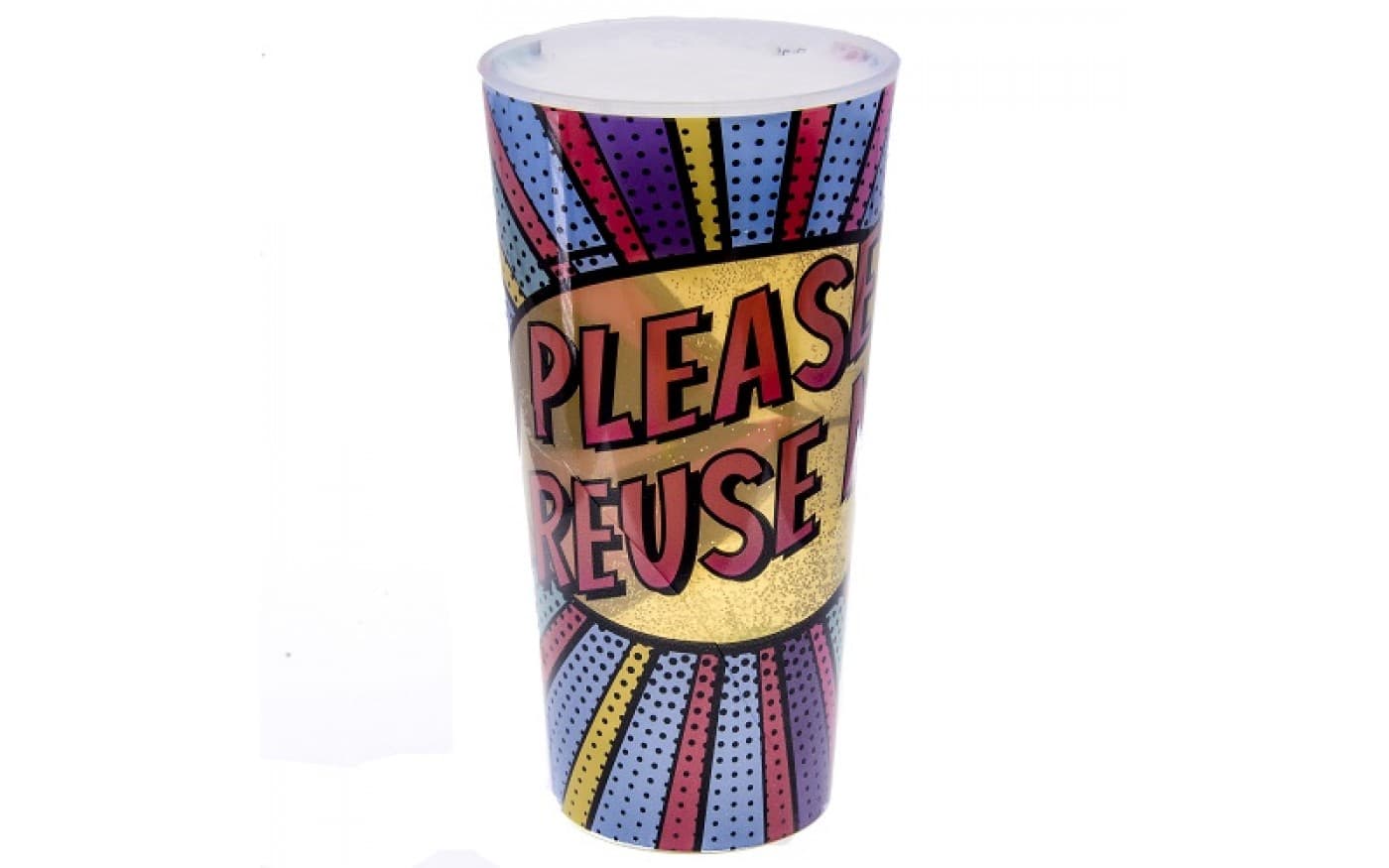
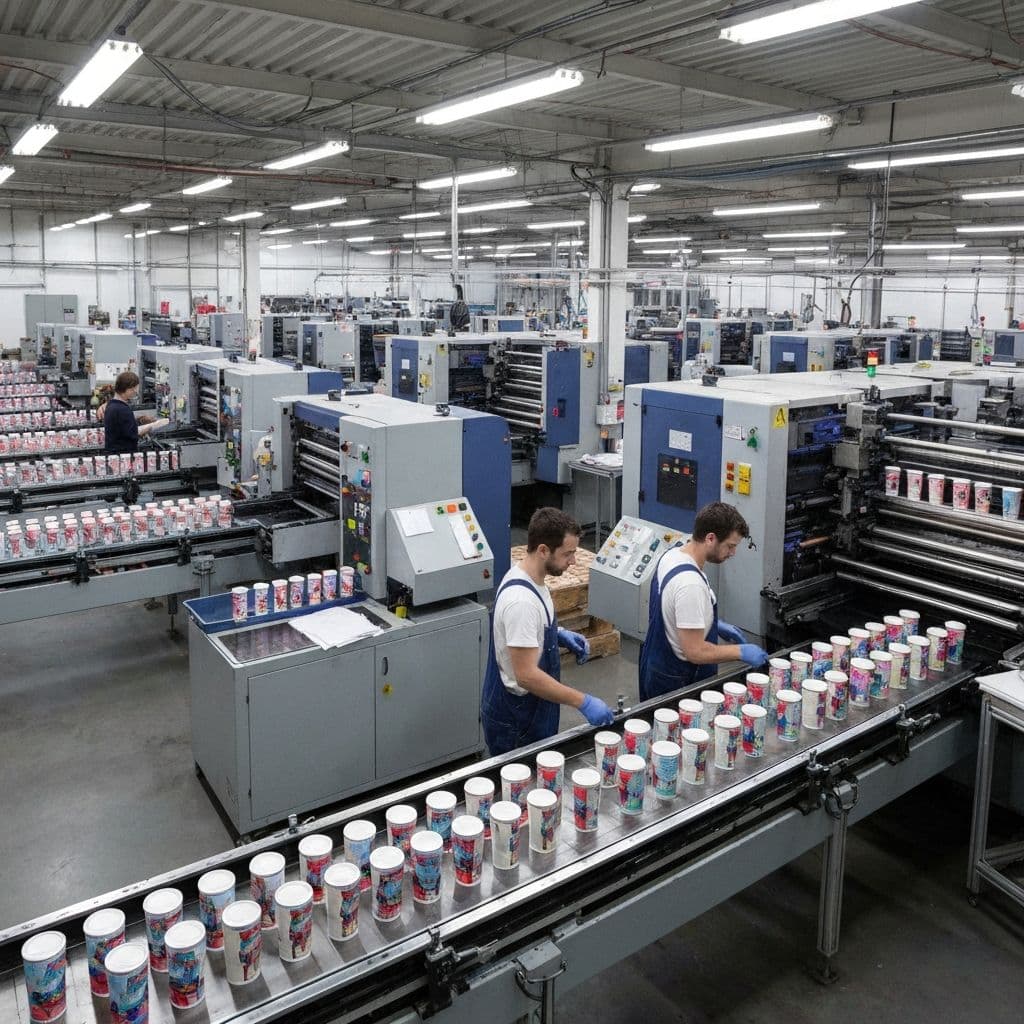
The pages of this site say the reusable event cups are printed in one colour or as a full-colour wrap around the cup. They do not say how the print is applied or which side of the cup wall carries it, and this article does not assume either. That is a question for the supplier, and the answer decides which paragraph of the Annex is engaged.
What to ask
Which side of the cup carries the print. How the ink is applied. How printed stock is stored and packed. And what documents the supplier holds to show good manufacturing practice and food contact compliance for the finished cup. Our guide to food safe reusable plastic cups covers the declaration of compliance for the plastic itself, and our guide to product safety for promotional cups covers the name, address and traceability details a cup should carry. If the artwork is still being prepared, start with the artwork checklist. When you are ready to order, ask for a quote and put the questions above in the request.
Where this stands
This was checked on 30 September 2026. Regulation 2023/2006 shows no known outstanding effects on legislation.gov.uk. The FSA's post implementation review of the England enforcement regulations of 2012 is dated 25 June 2026 on GOV.UK, but its text is older, as explained above. It is a report on how those regulations have worked and, on the pages read, does not change the ink rule described here. The text read is the UK version of the regulation on legislation.gov.uk. Food Standards Scotland's pages and the EU version of the regulation were not read.
Frequently Asked Questions
Is the ink on a printed cup regulated?
Yes. The Food Standards Agency's overview says the national food contact regulations of 2012 include provisions for materials such as printing inks, and the good manufacturing practice regulation, 2023/2006, has a specific part on printing inks applied to the non-food-contact side of a material or article.
What does the good manufacturing practice Annex require of printing ink?
Inks on the non-food-contact side must be formulated and/or applied so that substances from the printed surface do not transfer to the food-contact side through the substrate or by set-off in the stack or the reel at levels not in line with article 3 of Regulation 1935/2004. Printed articles must be handled and stored the same way, and printed surfaces shall not come into direct contact with food.
Is there a list of approved inks for food contact?
The sources read do not contain one. The FSA's post implementation review report lists the materials with specific measures: plastics, recycled plastics, ceramics, regenerated cellulose film, active and intelligent materials, vinyl chloride monomer and certain epoxy derivatives. Printing inks are not on it. The rule these sources set for them is the good manufacturing practice Annex read with article 3 of the framework regulation.
Does the rule apply to the printer as well as the cup maker?
Article 2 of Regulation 2023/2006 applies to all stages of manufacture, processing and distribution of materials and articles, up to but excluding the production of starting substances, and the Annex sets detailed rules for processes involving the application of printing inks. Article 4 makes the business operator responsible for ensuring that manufacturing operations are carried out in accordance with the general rules and the Annex. The regulation does not use the word printer, so who counts as the business operator for a given print job is a question to put to the supplier.
Which side of a cup counts as the food-contact side?
Article 3 of Regulation 2023/2006 defines the food-contact side as the surface directly in contact with food and the non-food-contact side as the surface that is not. For a drinking cup, the surface the drink touches is the food-contact side. How a particular supplier applies its print is a question to put to that supplier.
How we checked this article
Checked on 30 September 2026 against the legislation itself. The revised UK text on legislation.gov.uk was read for the Annex, part A, of Commission Regulation (EC) No 2023/2006 on good manufacturing practice (printing inks), for its articles 2, 3 and 4, and for article 3 of assimilated Regulation (EC) No 1935/2004. The site reports no known outstanding effects by UK legislation on any of them, and the Annex shows versions dated 2006, 2008 and 2020 only. The three paragraphs of part A are quoted or closely paraphrased, including its and/or wording, and article 2 is quoted with its exclusion of the production of starting substances. The Food Standards Agency's overview of the food contact materials regulations on GOV.UK is the oldest page cited: it carries the date 24 April 2018, GOV.UK records it as first published on 25 June 2026, the day the FSA moved its website to GOV.UK according to the FSA's announcement, and it applies to England, Northern Ireland and Wales. It was read for its statement that the national regulations of 2012 include provisions for materials like printing inks and adhesive labels; the statutory text confirms that inks are regulated. The FSA's post implementation review of the England Regulations 2012, published as a consultation pack, is dated 25 June 2026 on GOV.UK, but its text is older: it refers to amendments made in 2022 and to the Windsor Framework from autumn 2023 and mentions nothing later, so the page date and the date of the text differ and its list of specific measures is taken as the position when it was written. It applies to England only. It was read for its statements that the framework regulation applies to all food contact materials regardless of composition, for its list of the materials with specific measures, and for its description of the good manufacturing practice regulation. That report is a review of the enforcement regulations and does not itself change the rules described here. Food Standards Scotland's pages and the EU version of the regulation were not read. The way this site's cups are printed, and on which side of the cup wall, is not stated on its pages and is not asserted; the article marks that as a question for the supplier. The application of the Annex to a cup is this article's own reading and is marked as such.
- Published by
- Branded Cups Ltd
- Sources last checked
- 2026-09-30
Sources
- Commission Regulation (EC) No 2023/2006 on good manufacturing practice, Annex, part A: printing inks
- Commission Regulation (EC) No 2023/2006, article 2 (scope)
- Commission Regulation (EC) No 2023/2006, article 3 (definitions)
- Commission Regulation (EC) No 2023/2006, article 4 (conformity with good manufacturing practice)
- Assimilated Regulation (EC) No 1935/2004, article 3 (general requirements)
- Food Standards Agency, Food contact materials regulations (GOV.UK, 24 April 2018)
- Food Standards Agency, Consultation pack: review of the Materials and Articles in Contact with Food (England) Regulations 2012 (25 June 2026)
- Branded Cups, Reusable event cups
- Food Standards Agency, The Food Standards Agency moves to GOV.UK (25 June 2026)